jssm 5.109.0
Easy. Tiny. Fast. Finite state machines as one-liner strings, for TypeScript and JavaScript. Renders to PNG, SVG, and JPEG. Runs in Node, browsers, and Deno. MIT licensed.
import { sm } from 'jssm';

const TrafficLight = sm`Red -> Green -> Yellow -> Red;`;

TrafficLight.state();              // 'Red'
TrafficLight.transition('Green');  // true
TrafficLight.state();              // 'Green'
TrafficLight.transition('Red');    // false — Red is not reachable from Green
TrafficLight.transition('Blue');   // throws — Blue is not a state
A more involved machine, with main paths, forced paths, and per-state styling, renders to:
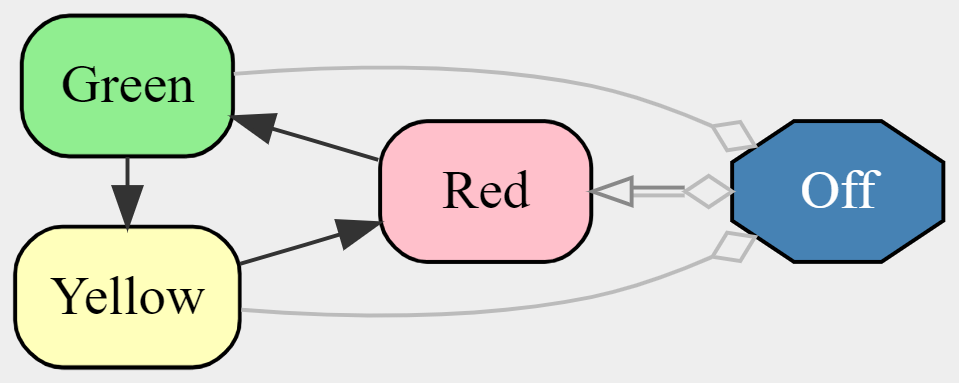
const TrafficLightWithOff = sm`
  Red => Green => Yellow => Red;
  [Red Yellow Green] ~> Off -> Red;

  flow: left;

  state Red    : { background-color: pink;        corners: rounded; };
  state Yellow : { background-color: lightyellow; corners: rounded; };
  state Green  : { background-color: lightgreen;  corners: rounded; };

  state Off    : {
    background-color : steelblue;
    text-color       : white;
    shape            : octagon;
    linestyle        : dashed;
  };
`;
The same string is the runtime and the diagram. They cannot drift apart.
Try it in the live editor · Documentation · Discord · Issues
Install
npm install jssmThe package ships pure ES6, a CommonJS ES5 bundle, an IIFE for browsers, and TypeScript typings. A Deno build is included. Node 10 or newer.
Visualization
jssm ships with a visualization subpath that renders state machines to
SVG using Graphviz (via @viz-js/viz).
import { sm }                  from 'jssm';
import { fsl_to_svg_string }   from 'jssm/viz';

const svg = await fsl_to_svg_string('a -> b;');
The viz subpath is opt-in — importing only from jssm does not pull in
@viz-js/viz. See the Visualization doc page for browser, ESM, and IIFE
usage patterns.
60-second tour
Actions let a machine advance without the caller knowing the next state:
const Light = sm`Red 'next' -> Green 'next' -> Yellow 'next' -> Red;`;

Light.action('next');  // true
Light.state();         // 'Green'
Light.action('next');  // true
Light.state();         // 'Yellow'
Three arrow types distinguish kinds of transition:
const Light = sm`
  Red => Green => Yellow => Red;     // => main path
  [Red Yellow Green] ~> Off -> Red;  // ~> forced, -> legal
`;
-> is a legal transition. => is a legal transition that is also part of
the main path. ~> is a transition that requires force_transition —
useful for emergency stops, resets, and other rarities.
Hooks observe and gate transitions:
const m = sm`Red 'next' -> Green 'next' -> Yellow 'next' -> Red;`
  .hook('Red', 'Green', () => console.log('GO'))            // specific edge
  .hook_entry('Red', () => console.log('STOP'))             // entering a state
  .hook_action('Yellow', 'Red', 'next', () => allowed());   // gate a specific action; return false to block
Pre-hooks fire before the state changes and may return false to refuse the
transition. Post-hooks fire after. Four *_everything hooks
(hook_pre_everything, hook_everything, hook_pre_post_everything,
hook_post_everything) bracket the entire pipeline if you want a single
observation point.
Refusals and errors are deliberately different. An illegal transition
returns false. An unknown state throws. Branching code can rely on the
distinction.
Why jssm
The big win: most state-machine libraries make you write a gargantuan JSON document, or call a builder API a few dozen times, to define a single machine. jssm machines are short, readable, arrow-driven strings — so they are easy to write, easy to read, easy to debug, and easy to share.
That decision shows up everywhere downstream:
A DSL with features other state-machine libraries don’t have. Three arrow types distinguish legal, main-path, and forced transitions. Array notation collapses repeated edges —
[Red Yellow Green] ~> Offreplaces three lines. Named actions, per-state styling, named edges, validators, and live visualization all live in the same string the runtime parses.Definition strings stay tiny, which makes machines easy to debug. The traffic light is one line; the full eight-step ATM walkthrough is thirty. Small enough to read top-to-bottom, diff in code review, paste into a bug report, or drop into the live editor for a rendered diagram you can step through.
Fast. Tens of millions of transitions per second on commodity hardware. See
src/buildjs/benchmark.cjsor runnpm run bennyagainst your own machine.More thoroughly tested than any other JavaScript state-machine library. 5,206 tests at 99.9% line coverage (report), plus fuzz testing via
fast-check, with parser test data across ten natural languages and Emoji.
Documentation
- What are state machines? — conceptual intro for newcomers
- Getting started — install and use the library across Node, browser, Deno, ES5/ES6, CDN, and TypeScript
- Tutorial: a four-state traffic light — short walkthrough that introduces the three arrow types
- Tutorial: building an ATM state machine — longer walkthrough that builds a real-world machine in nine incremental steps
- Language reference — DSL reference for people already comfortable with state machines
- Catalog of example machines — comparison table of worked examples (light switch, traffic light, intersection, vending machine, more)
- Generated API reference — full surface, generated from the TypeScript source
API at a glance
| Method | Purpose |
|---|---|
sm`...` |
Build a machine from DSL |
.state() |
The current state |
.transition(state) |
Move to a state. Returns false if illegal, throws if unknown. |
.force_transition(state) |
Move to a state across a ~> forced edge |
.action(name) |
Trigger a named action. The next state is derived from the current state. |
.valid_transition(state) · .valid_action(name) |
Test whether a transition or action is legal from the current state, without taking it |
.hook(from, to, fn) |
Run on a specific edge. Pre-hook; return false to block. |
.hook_entry(state, fn) · .hook_exit(state, fn) |
Run when entering or leaving a state |
.hook_action(from, to, action, fn) |
Run when a named action causes a specific edge |
.hook_pre_everything(fn) · .hook_everything(fn) |
Bracket the pre-hook pipeline |
.hook_pre_post_everything(fn) · .hook_post_everything(fn) |
Bracket the post-hook pipeline |
The full surface — including history, validators, factories, data, and the graph-introspection methods — is in the generated API docs.
Status
In production use since May 2017. Current series is 5.x and the DSL is stable; the runtime API has been additive for several years. MIT licensed end to end. Test data and parser cases are included for English, German, French, Spanish, Hebrew, Russian, Ukrainian, Belarusian, Bengali, Portuguese, and Emoji.
Community

Questions, design discussions, bug reports, and “what would you do for X?” are all welcome on Discord. Issues that need a paper trail go in the issue tracker.
Comparisons
A direct, head-to-head comparison with the other actively-maintained JS state machine libraries — XState, Stately.js, Finity, machina.js, and others — is in progress and will live in FeatureComparison.md.
A list of related projects, without commentary, is at the bottom of that file.
Contributing
Issues and PRs are welcome. The cheapest useful contribution is a language
test case: open a PR with
english.json
translated into your language. Translating
traffic_light.fsl
into a separate repo and publishing it goes a step further.
Acknowledgements
Michael Morgan has debated significant
sections of the notation, invented several concepts and operators, helped
with the parser and system nomenclature, and published the first non-author
FSL machine. Vat Raghavan participated
extensively in language design and implemented several features. Forest
Belton provided guidance, bugfixes, and
parser commentary. Jordan
Harbrand suggested two interesting features and
gave strong feedback on the initial tutorial draft.
Translation contributors:
- Mykhaylo Les — Ukrainian, Belarusian, Russian
- Tanvir Islam — Bengali (also published the first non-English
FSLmachine) - Francisco Junior — Portuguese
- Jeff Katz — German
- Alex Cresswell — Spanish
- Dvir Cohen — Hebrew
- David de la Peña — French
If your contribution is missing here, please open an issue.
Stats, coverage, and badges
5,206 tests, run 6,097 times.
- 5,197 specs with 99.9% coverage
- 9 fuzz tests with 9.9% coverage
- 3,481 TypeScript lines — 1.5 tests per line, 1.8 generated tests per line





